Here is a number that should stop every business owner, IT manager, and cybersecurity professional cold:
500+
That is the confirmed number of victims the Medusa ransomware gang phishing campaigns have claimed since 2021 — and the attacks are happening at a near-daily rate right now in 2025.
As of January 2026, more than 500 organisations have fallen victim to Medusa ransomware — and the pace is accelerating fast.
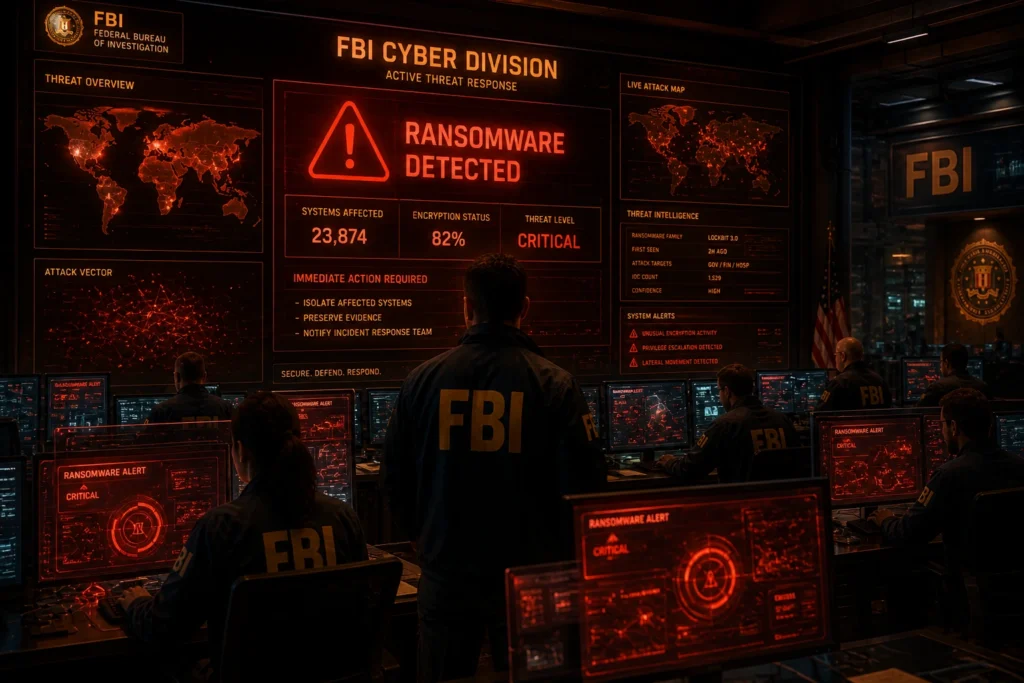
On March 12 2025 the FBI, CISA, and the Multi-State Information Sharing and Analysis Center (MS-ISAC) issued an urgent joint advisory warning organisations worldwide about Medusa ransomware gang phishing campaigns — one of the most dangerous and rapidly escalating double extortion ransomware threats targeting businesses, hospitals, schools, and government agencies right now.
Since the beginning of 2025 through May 11 2025 Intel 471 has recorded 90 entities that have purportedly been infected by Medusa or its affiliates putting the group in the top 10 most active for 2025.
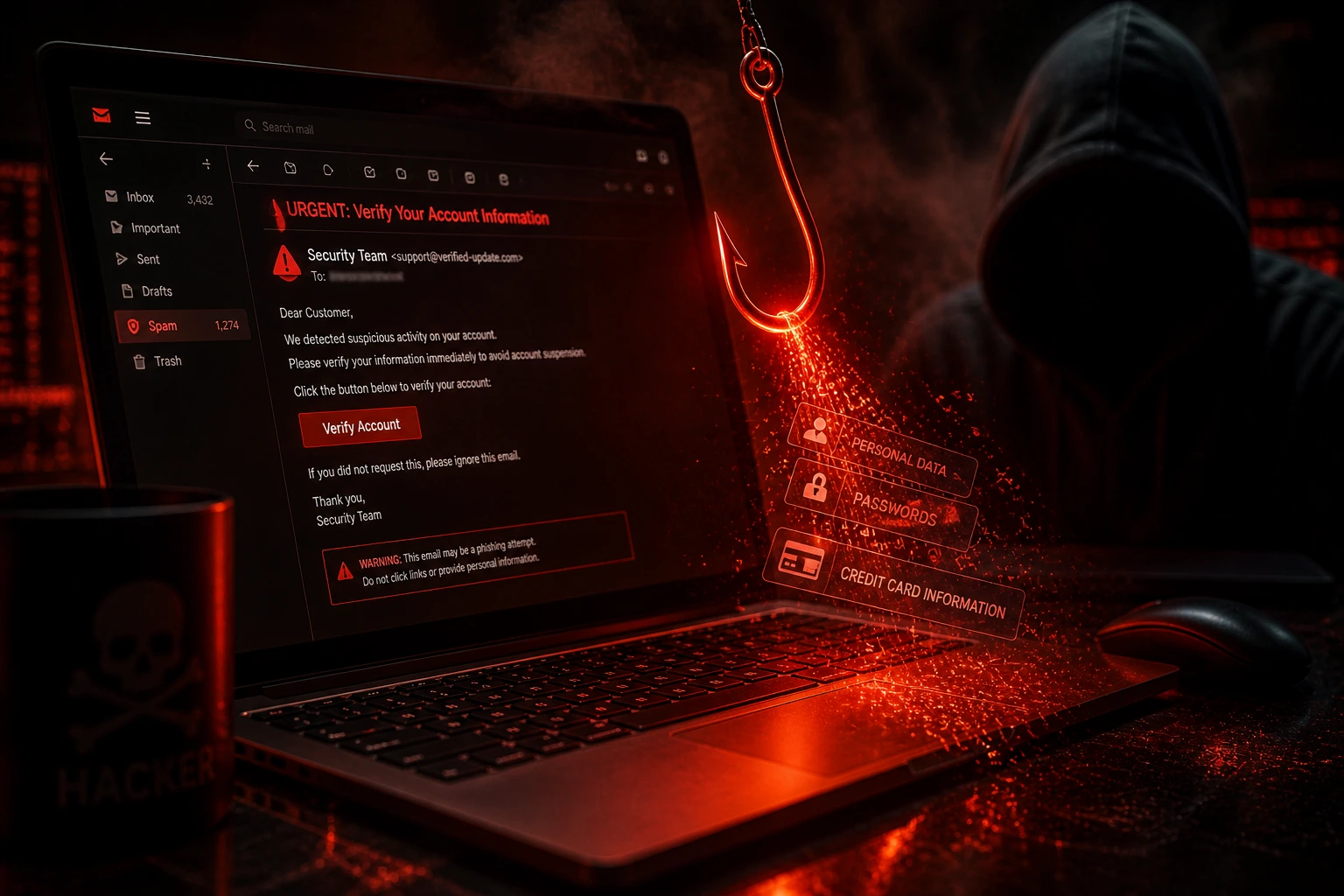
The scariest part? The Medusa ransomware gang gets in through your employees’ inboxes. A single clicked spear phishing attack. A single stolen password. That is all it takes to bring your entire organisation to its knees.
At FutureCyber.it we have rebuilt this guide from the ground up using the latest FBI and CISA data — covering what Medusa is, exactly how their Medusa phishing campaigns work, who they target, and the 12 critical steps you must take right now to protect yourself.
Table of Contents
What Is Medusa Ransomware? — The Complete Answer
Before we break down the Medusa ransomware gang phishing campaigns in detail you need to understand exactly what you are dealing with.
Medusa is a ransomware-as-a-service (RaaS) variant first identified in June 2021. As of February 2025 Medusa developers and affiliates have impacted over 300 victims from a variety of critical infrastructure sectors with affected industries including medical, education, legal, insurance, technology, and manufacturing.
The group mostly targets small and medium-sized entities with revenues ranging from US $5 million to US $50 million. The group practices double extortion where sensitive data is first discreetly extracted from systems that have been compromised. If an organisation does not pay a ransom for the decryption key Medusa threatens to release data on its data leak blog which it launched in 2023.
Here is what makes Medusa ransomware different from other ransomware-as-a-service groups — and far more dangerous:
| Feature | Detail |
|---|---|
| Type | Ransomware-as-a-Service (RaaS) |
| First Identified | June 2021 |
| Operating Model | Developers recruit affiliates via credential harvesting IABs |
| Extortion Method | Double extortion ransomware — encrypt AND publish data |
| Leak Site | Medusa Blog — dark web leak site launched 2023 |
| Ransom Range | $100,000 to $15 million per victim |
| Confirmed Victims | 500+ as of January 2026 |
| Attack Frequency | Near-daily in 2025 |
| Primary Entry | Medusa phishing campaigns and unpatched vulnerabilities |
| Affiliate Payments | $100 to $1 million per successful attack |
⚠️ Critical Note: The Medusa ransomware variant is completely unrelated to the MedusaLocker variant and the Medusa mobile malware variant per the FBI’s investigation. These are three entirely separate threats with no connection to each other.
The Shocking FBI Warning About Medusa Ransomware Gang Phishing Campaigns
Medusa is a ransomware-as-a-service variant used to conduct ransomware attacks — as of December 2024 over 300 victims from critical infrastructure sectors have been impacted. Medusa actors use common techniques like phishing campaigns and exploiting unpatched software vulnerabilities.
The Medusa ransomware gang routinely engages in double extortion where they demand an extortion payment to not publish stolen patient data and a payment for the decryption key to unlock encrypted data and systems. This gang exploits stolen credentials and known vulnerabilities.
And here is the part that should genuinely alarm every organisation — the discovery of triple extortion:
FBI investigations identified that after paying the ransom one victim was contacted by a separate Medusa actor who claimed the negotiator had stolen the ransom amount already paid and requested half of the payment be made again to provide the true decryptor — potentially indicating a triple extortion scheme.
Read that again. Victims who paid the ransom were extorted a second time by the same gang. Paying does not guarantee safety — it guarantees you become a target again.
Medusa Ransomware 2025 — The Shocking Statistics
The data tells the real story of how dangerous Medusa ransomware gang phishing campaigns have become in 2025:
| Statistic | Figure | Source |
|---|---|---|
| Total victims as of Jan 2026 | 500+ organisations | Darktrace |
| Confirmed critical infrastructure victims | 300+ as of Feb 2025 | FBI/CISA Advisory |
| Total recorded attacks | 414+ and growing | Cyble Intelligence |
| 2025 attack pace increase | 45% higher than 2024 | Cyble Intelligence |
| Victims in first 72 days of 2025 | 90 entities | Intel 471 |
| Q1 2025 ransomware surge overall | 2,289 incidents — 126% YoY | Check Point |
| UK victim share | 9% of all UK ransomware | Check Point |
| Total ransom operations value | $40 million+ | BlackFog |
| Attacks demanding $1M+ | 26% of all 2024 attacks | BlackFog/Dark web data |
| Maximum ransom demand | $15 million | Multiple confirmed reports |
| Toyota Financial Services demand | $8 million | BleepingComputer |
| Increase 2023 to 2024 | 42% surge | Symantec Threat Hunter |
The rise of the Medusa group is set against a historic ransomware surge in Q1 of 2025 with 2,289 reported incidents in the first three months of the year — more than double the number from the same period last year representing a 126% year-over-year increase.
How Do Medusa Ransomware Gang Phishing Campaigns Actually Work?
This is the section that could save your organisation. Understanding exactly how Medusa ransomware gang phishing campaigns operate step by step is your single most powerful defence.
Step 1 — Credential Harvesting Through Medusa Phishing Campaigns
Medusa IAB affiliates are known to make use of phishing campaigns as a primary method for stealing victim credentials and exploiting unpatched software vulnerabilities through Common Vulnerabilities and Exposures such as the ScreenConnect vulnerability and Fortinet EMS SQL injection vulnerability.
These Medusa phishing attacks are no longer simple spam emails. More sophisticated targeted spear phishing attacks have been reported that use AI to craft more believable text to better convince victims to click on links or download attachments that result in the ransomware’s installation.
7 Types of Medusa Gang Phishing Campaign Emails:
| Phishing Email Type | What It Pretends to Be | Risk Level |
|---|---|---|
| Delivery notices | FedEx, UPS, USPS, DHL packages | 🔴 Very High |
| Purchase receipts | Amazon, Walmart, Target orders | 🔴 Very High |
| Virus alerts | Fake IT security notices | 🔴 Very High |
| Voicemail messages | Audio message download links | 🟡 High |
| Financial documents | Fake invoices and payment requests | 🔴 Very High |
| Boss impersonation | CEO asking for urgent action | 🔴 Very High |
| Security software | Prompts to download fake tools | 🟡 High |
Step 2 — Living Off the Land (LoTL) After Medusa Phishing Access
Once the Medusa phishing campaign delivers initial access the gang does something extremely clever — they use your own legitimate tools against you to avoid detection.
Once inside a network Medusa employs sophisticated strategies to maximise impact. The group executes Base64-encrypted commands via PowerShell to avoid detection and utilises tools like Mimikatz to extract credentials from memory facilitating further network compromise. They also leverage legitimate remote access software including AnyDesk and ConnectWise as well as tools like PsExec and RDP to propagate across the network.
This living off the land attack technique makes the Medusa ransomware gang extremely difficult to detect because their activity looks identical to normal IT operations.
Step 3 — Credential Theft and Lateral Movement
The Medusa gang phishing campaign does not stop at credentials — it goes much deeper. After gaining initial phishing campaign access attackers use Mimikatz for credential theft then move laterally across your entire network using Remote Desktop Protocol (RDP) stealing data from every system they can reach.
Medusa ransomware increasingly exploits remote monitoring and management (RMM) tools for persistence, lateral movement, and data exfiltration. Threat actors including nation-state actors and ransomware groups like Medusa abuse legitimate commercial RMM tools typically used by system administrators for remote monitoring, software deployment, and device configuration instead of relying on remote access trojans.
Step 4 — Disabling Your Endpoint Detection and Response
In some instances Medusa actors attempted to use vulnerable or signed drivers to kill or delete endpoint detection and response (EDR) tools.
This is the Bring Your Own Vulnerable Driver (BYOVD) attack — one of the most sophisticated critical infrastructure attack techniques in the ransomware toolkit designed specifically to neutralise your defences before the final encryption blow.
Step 5 — Data Exfiltration Before Encryption
This final stage of the Medusa ransomware phishing campaign is devastating — and is what makes the double extortion model so powerful.
Encryption processes add a .MEDUSA extension to each of the victim’s files. Ransom notes are delivered via a !!!READ_ME_MEDUSA!!!.txt that provides instructions a unique identifier and warnings of future actions if payment is not made. The attack is then announced on the Medusa Blog.
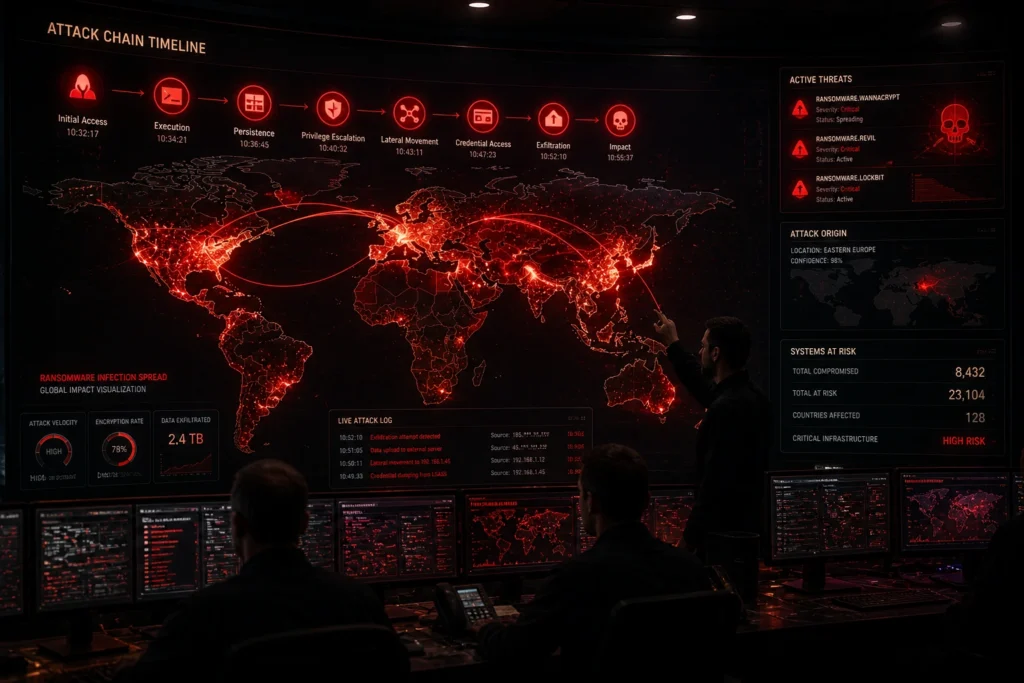
The Complete Medusa Ransomware Gang Phishing Campaign Attack Chain:
| Phase | Action | Tools Used |
|---|---|---|
| 1. Medusa Phishing Campaign | Credential harvesting via phishing emails | AI-enhanced spear phishing |
| 2. Initial Access | Login with stolen credentials or exploit CVE | CVE-2024-1709, CVE-2023-48788 |
| 3. Reconnaissance | Map network targets | Advanced IP Scanner, SoftPerfect |
| 4. Credential Theft | Extract passwords from memory | Mimikatz, keyloggers |
| 5. Lateral Movement | Spread across network | RDP, PowerShell, PsExec |
| 6. Defence Evasion | Kill EDR and antivirus tools | BYOVD techniques |
| 7. Data Exfiltration | Steal all sensitive data | Tor, PowerShell scripts |
| 8. Encryption | Encrypt files — add .MEDUSA extension | Custom encryption engine |
| 9. Cyber Extortion | Demand ransom with countdown timer | Medusa Blog, dark web leak site |
Medusa Ransomware TTPs — Complete Technical Analysis
For cybersecurity professionals and IT teams here is the complete Medusa ransomware TTPs breakdown based directly on FBI and CISA advisory data:
Initial Access TTPs
| Technique | MITRE ATT&CK ID | Description |
|---|---|---|
| Phishing for credentials | T1566 | Core Medusa gang phishing campaign method |
| Exploit public-facing apps | T1190 | CVE-2024-1709, CVE-2023-48788 |
| Valid accounts | T1078 | Stolen credentials from credential harvesting |
| IAB purchased access | T1078.004 | Buying access from initial access brokers |
Execution and Persistence TTPs
| Technique | MITRE ATT&CK ID | Description |
|---|---|---|
| PowerShell | T1059.001 | Base64 encoded commands to evade detection |
| WMI | T1047 | System information and lateral movement |
| Scheduled Tasks | T1053 | Persistence after initial ransomware phishing access |
| RMM Tool Abuse | T1219 | AnyDesk, ConnectWise, Splashtop, SimpleHelp |
Defence Evasion TTPs
| Technique | MITRE ATT&CK ID | Description |
|---|---|---|
| BYOVD | T1562.001 | Kill endpoint detection response with vulnerable drivers |
| Delete PowerShell history | T1070 | Cover tracks after execution |
| Disable security software | T1562 | Neutralise antivirus and EDR |
| COM Object manipulation | T1546 | Privilege escalation technique |
Known Exploited Vulnerabilities in Medusa Ransomware Campaigns:
| CVE | System | Description |
|---|---|---|
| CVE-2024-1709 | ConnectWise ScreenConnect | Authentication bypass |
| CVE-2023-48788 | Fortinet EMS | SQL injection vulnerability |
| CVE-2021-34473 | Microsoft Exchange (ProxyShell) | Remote code execution |
Who Has the Medusa Ransomware Gang Targeted?
The Medusa ransomware gang phishing campaigns do not discriminate. Here is a complete breakdown of victims and industries targeted:
Industries Targeted by Medusa Ransomware Phishing
| Industry | Risk Level | Why Targeted |
|---|---|---|
| Healthcare/Medical | 🔴 Critical | Patient data extremely valuable — critical infrastructure attack |
| Education | 🔴 Critical | Large networks, limited security budgets |
| Legal | 🔴 Critical | Highly sensitive client and case data |
| Insurance | 🟡 High | Financial data and PII goldmine |
| Technology | 🟡 High | Intellectual property access |
| Manufacturing | 🟡 High | OT systems and supply chain disruption |
| Government | 🟡 High | Critical infrastructure and citizen data |
Notable Confirmed Medusa Ransomware Victims
| Victim | Industry | Ransom Demand | Data Stolen |
|---|---|---|---|
| Toyota Financial Services | Automotive/Finance | $8 million | Financial docs, passwords, passports |
| Minneapolis Public Schools | Education | $1 million | Student records published |
| Philadelphia Inquirer | Media | Undisclosed | Publishing operations disrupted |
| 300+ critical infrastructure orgs | Multiple | $100K — $15M | FBI confirmed Feb 2025 |
| 500+ total organisations | Multiple | Varies | Confirmed Jan 2026 |
BlackFog reported that Medusa is one of the leading ransomware threats with operations surpassing $40 million in ransom demands. Posts on the dark web have provided some insight into the group’s activities showing that in 2024 more than 26 percent of their disclosed attacks involved ransom demands exceeding $1 million.
Can Medusa Ransomware Be Decrypted? — Honest Answer
One of the most important questions victims of Medusa ransomware gang phishing campaigns ask is whether Medusa ransomware decryption is possible without paying.
Here is the completely honest answer:
| Medusa Ransomware Decryption Option | Feasibility | Important Notes |
|---|---|---|
| Pay the ransom | Risky — not recommended | Triple extortion risk confirmed by FBI |
| Free decryption tool | Not available | No public decryptor exists currently |
| Restore from backup | ✅ Best option | Only works if backups are clean and offline |
| Law enforcement assistance | Limited | Report to FBI IC3 — they may have tools |
| Negotiate ransom down | Sometimes possible | Professional ransomware negotiators exist |
The most alarming Medusa ransomware decryption reality comes directly from the FBI:
After paying the ransom one victim was contacted by a separate Medusa actor who claimed the negotiator had stolen the ransom amount already paid and requested half of the payment be made again to provide the true decryptor — potentially indicating a triple extortion scheme.
FutureCyber.it recommendation: Never pay the ransom. Report immediately to FBI IC3 at ic3.gov and restore from offline backups.

Medusa Android — Is It the Same as Medusa Ransomware?
Many people searching for Medusa ransomware also search for Medusa Android. Here is the critical clarification:
The Medusa ransomware variant is completely unrelated to the MedusaLocker variant and the Medusa mobile malware variant per the FBI’s investigation.
TgToxic — also known as ToxicPanda — is a rapidly evolving Android banking trojan targeting users in Asia and Europe that is sometimes confused with Medusa Android malware. The malware is distributed via dropper APKs likely through phishing or SMS campaigns.
| Threat Name | Platform | Type | Same Gang? |
|---|---|---|---|
| Medusa Ransomware | Windows | RaaS double extortion ransomware | This article |
| MedusaLocker | Windows | Separate ransomware | ❌ No |
| Medusa Android | Android | Banking trojan | ❌ No |
| Medusa Virus Analog Horror | YouTube | Fictional horror series | ❌ Not a virus |
What Is the Security Risk of Phishing? — The Data
Since Medusa ransomware gang phishing campaigns are the primary attack vector understanding the full security risk of phishing is essential for every organisation.
Roger Grimes data-driven defense evangelist at KnowBe4 stated that social engineering is involved in 70% to 90% of all successful hacking attacks — and yet many organisations still do not prioritise security awareness training as a primary countermeasure against ransomware phishing threats like Medusa.
The Security Risk of Phishing in 2025 — Complete Data Table:
| Security Risk | Statistic | Impact |
|---|---|---|
| Attacks starting with phishing | 70% — 90% of all breaches | Every organisation |
| Average phishing breach cost | $4.9 million | Financial devastation |
| AI-enhanced spear phishing | 3x higher success rate | Harder to detect |
| Employees clicking without training | 1 in 3 | Massive exposure |
| Employees clicking with training | 1 in 20 | 6x improvement |
| Time to detect phishing breach | Average 197 days | 6 months of exposure |
| Medusa phishing campaign frequency | Near-daily in 2025 | Constant threat |
How to Protect Yourself From Medusa Ransomware Gang Phishing Campaigns — 12 Critical Steps
Here is your complete protection guide based on FBI and CISA recommendations combined with FutureCyber.it expert analysis — every step designed to stop Medusa ransomware gang phishing campaigns before they reach your data.
Immediate Actions — Do These Today
| Priority Action | Why It Stops Medusa Phishing Campaigns | How to Implement |
|---|---|---|
| Patch CVE-2024-1709 and CVE-2023-48788 | Closes primary Medusa ransomware entry points | Enable automatic patching now |
| Enable phishing-resistant MFA | Blocks credential harvesting even if passwords stolen | Authenticator app not SMS |
| Train employees on phishing | Stops Medusa phishing attacks at the human layer | Monthly simulations |
| Audit all remote access tools | Medusa abuses AnyDesk ConnectWise Splashtop | Remove all unused RMM tools |
| Create offline backups | Only true recovery from ransomware phishing attack | 3-2-1 backup rule |
| Deploy EDR solution | Detects living off the land attack techniques | CrowdStrike, SentinelOne |
| Implement zero trust security | Limits lateral movement after spear phishing breach | Zero trust architecture |
Network Security Against Medusa Ransomware Phishing
Immediate actions organisations can take to mitigate Medusa ransomware activity include ensuring operating systems software and firmware are patched and up to date and segmenting networks to restrict lateral movement after a Medusa phishing campaign breach.
| Network Action | How It Stops Medusa Gang | Implementation |
|---|---|---|
| Network segmentation | Stops lateral movement after phishing breach | VLAN separation |
| Filter network traffic | Blocks C2 communication after Medusa phishing | Firewall rules |
| Disable unused RDP | Removes primary Medusa ransomware lateral movement tool | Group Policy |
| Monitor PowerShell | Detects LoTL attack techniques | SIEM alerting |
| Block BYOVD | Enables Windows Vulnerable Driver Blocklist | Windows security settings |
Employee Training — Your Human Firewall Against Medusa Phishing
Training employees to recognise Medusa ransomware gang phishing campaigns provides an important layer of defence that technology alone just cannot achieve. Effective training focuses on recognising urgent requests, examining communication sources, and reporting suspicious activity immediately.
7 Phishing Red Flags Every Employee Must Know:
| Red Flag | Medusa Phishing Example | Action to Take |
|---|---|---|
| Urgent language | “Your account suspended in 24 hours” | Never click — verify directly |
| Unexpected attachment | Delivery receipt PDF from unknown | Delete immediately |
| Mismatched email | support@amaz0n-security.com | Report to IT |
| Password reset | IT asking for credentials via email | Report immediately |
| Fake invoice | Payment request from unknown vendor | Verify by phone |
| Virus alert | Pop-up claiming infection | Call IT directly |
| Boss impersonation | CEO urgent wire transfer request | Verify in person |
Incident Response — If Medusa Ransomware Hits You
| Step | Action | Timeline |
|---|---|---|
| 1 | Isolate ALL affected systems immediately | Within minutes |
| 2 | Preserve evidence — do not wipe systems | Immediately |
| 3 | Report to FBI IC3 at ic3.gov | Within hours |
| 4 | Report to CISA at report@cisa.gov | Within hours |
| 5 | Contact legal counsel and cyber insurance | Within hours |
| 6 | Do NOT pay ransom — triple extortion risk | Before any payment |
| 7 | Restore from clean offline backups | As soon as confirmed clean |
| 8 | Conduct full post-incident forensic review | Within 2 weeks |
The Medusa Ransomware Blog — How the Gang Pressure Victims
The Medusa ransomware group launched its own dark web leak site in 2023 known as the Medusa Blog. The group publishes sensitive information on the site when victims refuse to pay ransoms. Unlike many other ransomware groups Medusa uses public channels including Telegram under pseudonyms “Robert Vroofdown” and “Robert Enaber” to publicly pressure victims into paying ransoms while building its reputation in the RaaS marketplace.
The Medusa Blog Cyber Extortion Timeline:
| Day | Medusa Gang Action | Victim Pressure Level |
|---|---|---|
| Day 0 | Attack confirmed — ransom demand sent | 🟡 Moderate |
| Day 1-3 | Countdown timer published on Medusa Blog | 🟡 High |
| Day 3-7 | Victim name and partial data previewed | 🔴 Extreme |
| Day 7+ | Full data published or auctioned | 🔴 Maximum |
| Any time | Triple extortion demand sent to paying victims | 🔴 Devastating |
People Also Search
Q: What is the Medusa ransomware gang? A: The Medusa ransomware gang is a ransomware-as-a-service (RaaS) group first identified in June 2021. It recruits affiliate partners via initial access brokers who conduct Medusa phishing campaigns and exploit unpatched vulnerabilities to gain entry. The gang uses double extortion ransomware tactics — encrypting data and threatening to publish it on their dark web Medusa Blog. As of January 2026 more than 500 organisations have fallen victim to Medusa ransomware.
Q: How do Medusa ransomware gang phishing campaigns work? A: Medusa ransomware gang phishing campaigns work in five stages. First affiliates send spear phishing attacks via email pretending to be delivery notices, invoices, or virus alerts to steal employee credentials. Second they use those stolen credentials to access the network. Third they deploy living off the land attack techniques using legitimate tools like PowerShell and RDP to move laterally. Fourth they disable endpoint detection response tools using BYOVD attacks. Fifth they exfiltrate all data then encrypt everything adding a .MEDUSA extension before demanding ransom.
Q: What did the FBI say about Medusa ransomware in 2025? A: The FBI issued a joint advisory with CISA and MS-ISAC on March 12 2025 warning that Medusa ransomware gang phishing campaigns have impacted over 300 critical infrastructure victims. The advisory revealed Medusa uses credential harvesting phishing and vulnerability exploitation for access, living off the land attacks to evade detection, and a potential triple extortion scheme where victims who pay are subsequently extorted again. The FBI urges all victims to report to ic3.gov immediately.
Q: Is there a Medusa ransomware decryption tool? A: No free public Medusa ransomware decryption tool currently exists. Restoring from clean offline backups is the only guaranteed recovery method. The FBI strongly advises against paying the ransom because confirmed cases of triple extortion show that paying does not guarantee you receive a working decryptor — it may simply make you a target for a second demand.
Q: What industries does the Medusa ransomware gang target? A: The Medusa ransomware gang phishing campaigns target critical infrastructure sectors including healthcare, education, legal, insurance, technology, and manufacturing. Notable victims include Toyota Financial Services hit with an $8 million ransom demand, Minneapolis Public Schools, and 500+ total organisations confirmed by January 2026. The gang primarily focuses on small and medium businesses with revenues between $5 million and $50 million.
Q: What are Medusa ransomware TTPs? A: Medusa ransomware TTPs include phishing campaigns for credential harvesting (T1566), exploitation of CVE-2024-1709 and CVE-2023-48788 (T1190), PowerShell Base64 execution (T1059.001), Mimikatz for credential theft, RDP for lateral movement, BYOVD attacks to kill endpoint detection response tools (T1562.001), and Tor plus PowerShell for data exfiltration before adding the .MEDUSA extension. Remote access tools abused include AnyDesk, ConnectWise, and Splashtop.
Q: What is the security risk of phishing in 2025? A: The security risk of phishing in 2025 is the single biggest cybersecurity threat facing organisations today. Phishing is responsible for 70% to 90% of all successful cyberattacks including Medusa ransomware gang phishing campaigns. The average cost of a phishing-caused breach is $4.9 million. AI-enhanced spear phishing attacks used by the Medusa gang have a 3x higher success rate than traditional phishing. Without regular training 1 in 3 employees will click a phishing email — with training that drops to 1 in 20.
Q: Is Medusa Android the same as Medusa ransomware? A: No. Medusa Android is a completely separate banking trojan that steals banking credentials and SMS messages from Android devices. It has no connection to the Medusa ransomware gang phishing campaigns described in the FBI advisory. The FBI has confirmed the Medusa ransomware variant is unrelated to both MedusaLocker and the Medusa mobile malware varian
Q: What is the Medusa ransom gang blog? A: The Medusa ransom gang blog — also called the Medusa Blog — is a dark web leak site launched in 2023. When victims of Medusa ransomware gang phishing campaigns refuse to pay the ransom the gang publishes their stolen data publicly on this site with countdown timers. The gang also uses Telegram channels under pseudonyms to publicly shame victims and pressure payment through cyber extortion. In some cases even paying victims are subsequently contacted for additional payment in a triple extortion scheme.
FAQ
Q: What are Medusa ransomware gang phishing campaigns?
Medusa ransomware gang phishing campaigns are targeted spear phishing attacks using AI-enhanced fake emails — pretending to be delivery notices, invoices, virus alerts, or messages from trusted contacts — designed to steal employee credentials and deliver ransomware. They are the primary attack vector used by the Medusa ransomware-as-a-service gang which has infected 500+ organisations worldwide as of January 2026.
Q: What is Medusa ransomware 2025?
Medusa ransomware 2025 refers to the dramatic escalation of Medusa gang activity this year — with attacks running 45% higher than 2024, 90 confirmed victims in the first 72 days alone, and a landmark FBI and CISA joint advisory issued March 12 2025 warning of Medusa phishing campaigns targeting critical infrastructure worldwide.
Q: What are the Medusa ransomware TTPs?
Medusa ransomware TTPs include phishing for credential harvesting, CVE exploitation for initial access, PowerShell living off the land attacks, Mimikatz credential theft, RDP lateral movement, BYOVD endpoint detection response killing, Tor data exfiltration, and .MEDUSA file extension encryption followed by double extortion ransomware demands via their dark web leak site.
Q: Is Medusa ransomware decryption possible?
No free Medusa ransomware decryption tool is currently available. The only reliable recovery from a Medusa phishing campaign attack is restoring from clean offline backups. The FBI confirms paying the ransom risks triple extortion — where paying victims are contacted again demanding further payment for the real decryptor.
Q: What is the Medusa ransomware FBI warning?
The Medusa ransomware FBI warning is a joint advisory issued March 12 2025 by the FBI, CISA, and MS-ISAC. It confirms 300+ critical infrastructure victims of Medusa gang phishing campaigns, details all TTPs and exploited CVEs, warns of triple extortion schemes, and recommends 15 specific mitigations including patching, phishing-resistant MFA, network segmentation, zero trust security, and offline backups.
Q: What is Medusa Android?
Medusa Android is a banking trojan targeting Android devices — completely unrelated to the Medusa ransomware gang phishing campaigns described in the FBI advisory. The FBI has confirmed these are entirely separate threat actors sharing only a name.
Q: Where can I get Medusa ransomware news?
You can get the latest Medusa ransomware news at FutureCyber.it — your trusted source for breaking cybersecurity news, threat intelligence, and protection guides. We monitor the Medusa gang and all major ransomware-as-a-service threats continuously and publish regular updates as new developments emerge.
Q: What is the Medusa ransom gang blog?
The Medusa ransom gang blog is a dark web leak site where the Medusa ransomware gang publicly shames victims of their phishing campaigns who refuse to pay. Launched in 2023 it features countdown timers, victim names, and stolen data previews. It is the gang’s primary cyber extortion pressure tool and operates alongside their Telegram channels for maximum victim pressure.
Conclusion — Protect Your Organisation From Medusa Ransomware Gang Phishing Campaigns Now
The Medusa ransomware gang phishing campaigns are not slowing down. They are accelerating — 500+ victims confirmed, 45% more attacks in 2025 than 2024, near-daily incident rates, and an FBI warning that every organisation must take seriously right now.
Businesses that fall victim to Medusa ransomware are typically pressured into paying ransoms via double extortion techniques where the group threatens to publicly release sensitive data and ruin their reputations. This highlights the need for robust security postures with specific controls for preventing and removing ransomware.
The good news is that the vast majority of Medusa ransomware gang phishing campaign infections are entirely preventable. Phishing-resistant MFA, employee training on spear phishing attacks, patch management for known CVEs, zero trust security architecture, network segmentation, and offline backups — these are not complicated measures. They are exactly what the FBI recommends.
Do not become one of the 500+ victims. Do not wait for the Medusa phishing campaign email to land in your employee’s inbox. Implement the 12 protection steps in this guide today.
At FutureCyber.it we are committed to keeping you ahead of the most dangerous cybersecurity threats including Medusa ransomware gang phishing campaigns and every emerging threat that follows. Bookmark this page share it with your IT team and check back regularly for the latest Medusa ransomware news and cybersecurity updates.
Report a Medusa ransomware phishing campaign incident right now:
- FBI IC3: ic3.gov
- CISA: report@cisa.gov or 1-844-Say-CISA.