
The automotive cybersecurity news coming out of 2026 is nothing short of alarming. Cars are no longer just machines — they are rolling data centres packed with software, cloud connections, AI systems, and wireless features. And hackers have noticed.
Ransomware attacks on automotive and smart mobility sectors more than doubled in 2025, driven by the rapid expansion of APIs and AI-driven architectures alongside increasingly sophisticated organised threat actors.
Industry analysts documented nearly 500 publicly reported automotive cybersecurity incidents across the mobility ecosystem in 2025 alone — a sharp year-over-year increase that shows no signs of slowing.
At FutureCyber.it, we are bringing you the most comprehensive and up-to-date guide to automotive cybersecurity news in 2026 — covering the biggest attacks, the latest regulations, career opportunities, salary information, and everything you need to know to stay informed and protected.
Table of Contents
What Is Automotive Cybersecurity?
Automotive cybersecurity is the practice of protecting connected vehicles, automotive networks, manufacturing systems, and smart mobility infrastructure from cyber threats. As modern vehicles become increasingly software-defined and connected to the internet, cloud platforms, and mobile apps, the attack surface has expanded dramatically.
| Automotive Cybersecurity Area | What It Protects |
|---|---|
| Connected Vehicles | In-car software, telematics, and remote access systems |
| Over-the-Air Updates | Software update delivery systems |
| APIs and Cloud Systems | Backend platforms connecting vehicles to services |
| Manufacturing Systems | Factory automation and production networks |
| EV Charging Networks | Electric vehicle charging infrastructure |
| Supply Chain | Third-party supplier networks and components |
| Mobile Apps | Companion apps controlling vehicle functions |
Automotive Cybersecurity News Today 2026 — The Shocking Numbers
The latest automotive cybersecurity news today paints a deeply concerning picture for the industry. Here are the most critical statistics from the 2026 Global Automotive and Smart Mobility Cybersecurity Report by Upstream Security:
| Statistic | Figure |
|---|---|
| Total reported incidents in 2025 | 494 publicly reported cases |
| Ransomware share of attacks | 44% — double the 2024 figure |
| Remote attacks | 92% of all automotive cyberattacks |
| No physical proximity required | 86% of remote attacks |
| Telematics and cloud attacks | 67% of all incidents |
| Data and privacy breaches | 68% of incidents |
| Business disruption incidents | 34% of incidents |
| Large scale events | 61% could impact thousands to millions of vehicles |
| Massive scale events | 20% were massive-scale attacks |
| Black hat actors | 71% of attacks — up from 65% in 2024 |
Ransom related incidents accounted for 44% of all reported incidents, doubling in number versus 2024 and reflecting the continued industrialisation of cybercrime. As organised threat actors increasingly exploited AI-driven backend platforms and APIs, ransom incidents shifted from isolated disruptions to ecosystem-level events capable of impacting operations, services, and mobility data at scale.
Upstream Security — The Leader in Automotive Cybersecurity
Upstream Security is the world’s leading AI-powered cybersecurity detection and response platform purpose-built for connected vehicles, physical AI, and smart mobility.
Upstream operates a cloud-based, AI-powered data management platform purpose-built for connected vehicles, smart mobility, physical AI and the IoT ecosystem. The company is backed by Alliance Ventures — operated by Renault, Nissan and Mitsubishi — as well as Volvo Group, BMW and Hyundai Motor Group.
Upstream Auto publishes the annual Global Automotive and Smart Mobility Cybersecurity Report — now in its eighth year — which has become the definitive source for automotive cybersecurity news worldwide.
| Upstream Security Fact | Detail |
|---|---|
| Founded | 2017 |
| Headquarters | Birmingham, Michigan, USA |
| Platform Type | AI-powered XDR for connected vehicles |
| Backed By | BMW, Volvo, Renault, Nissan, Hyundai |
| Annual Report | Global Automotive Cybersecurity Report |
| Report Year | Now in 8th year — 2026 edition released February 18, 2026 |
Biggest Automotive Cybersecurity News Stories of 2025-2026

1. Jaguar Land Rover Ransomware Attack
One of the most high-profile ransomware incidents of 2025 was the cyberattack on Jaguar Land Rover in September, which halted production for nearly six weeks and served as a strong reminder of how fast the repercussions of a cyberattack can spread through global operations.
This attack sent shockwaves through the entire automotive industry and became the defining automotive cybersecurity news story of 2025.
2. Hackers Lock Drivers Out of Their Own Vehicles
In one of the most alarming developments in automotive cybersecurity news, in mid-2025 attackers accessed remote vehicle command and control systems via companion apps, locked owners out, took remote control of functions like ignition and door locks, and demanded ransom payment to restore access.
This marked a terrifying new chapter in vehicle cyber attacks — moving ransomware from enterprise IT systems directly into the cars people drive every day.
3. European OEM Production Shutdown
In one of 2025’s most severe incidents, a cyberattack on a European OEM reportedly halted production for weeks and had broader economic effects across its supply chain.
4. Supply Chain Vulnerabilities Exposed
A separate report uncovered more than 1,500 supply chain vulnerabilities in modern automotive ecosystems, presenting a major cybersecurity challenge for the entire industry.
Vehicle Cyber Attacks — Most Common Types in 2026
Understanding vehicle cyber attacks is essential for both industry professionals and everyday drivers. Here are the most common attack types:
1. Ransomware Attacks
Ransomware, data theft, business interruption, and lateral movement across interconnected operations remain top concerns in the automotive sector. Ransomware now accounts for 44% of all automotive cyber incidents.
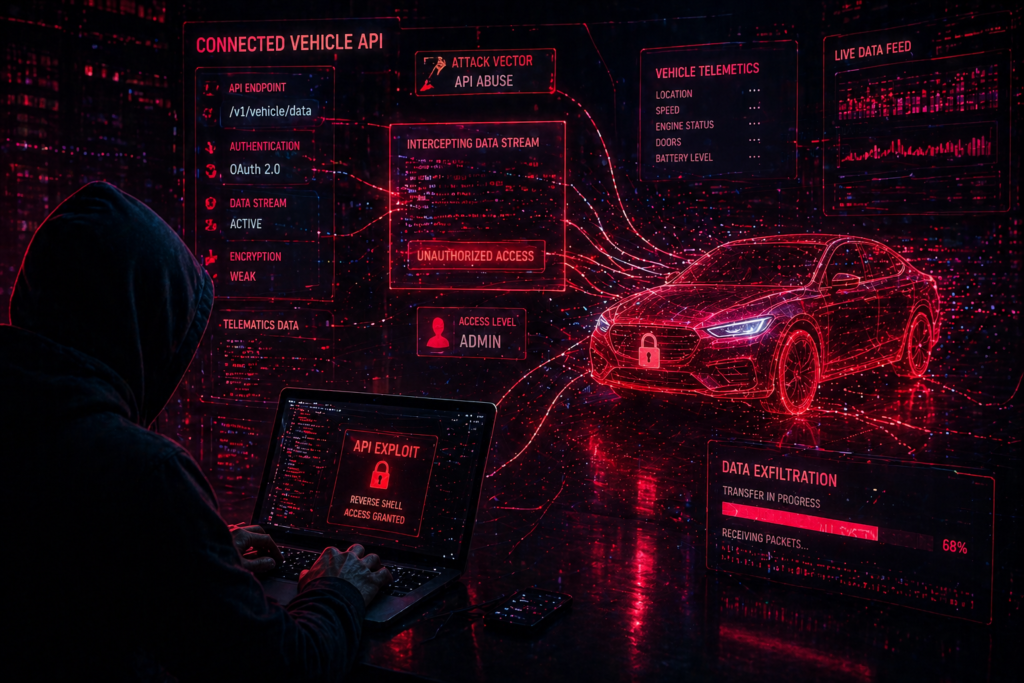
2. API and Telematics Attacks
APIs continue to serve as the nervous system of the automotive and smart mobility ecosystem and the enabler of a significant portion of incidents, with 67% of attacks involving telematics and cloud systems.
3. OTA Update Exploitation
Over-the-air software updates — designed to improve vehicles — have become a major attack vector. Hackers exploit vulnerabilities in update delivery systems to push malicious code to entire vehicle fleets simultaneously.
4. Companion App Attacks
Mobile apps that control vehicle functions like remote start, door locks, and climate control are increasingly targeted. The mid-2025 ransom attack used companion app vulnerabilities to lock drivers out of their own vehicles.

5. Supply Chain Attacks
Just one compromised component or supplier can cause delays, recalls or security issues that impact multiple vehicle lines, forcing manufacturers to look more closely at how they evaluate suppliers and how much insight they have into third-party code.
| Attack Type | Share of Incidents | Primary Target |
|---|---|---|
| Ransomware | 44% | Manufacturers and suppliers |
| API/Telematics | 67% involved | Cloud and backend systems |
| Data Breaches | 68% involved | Customer and vehicle data |
| OTA Exploitation | Growing | Vehicle software systems |
| Companion App | Emerging | Individual vehicle owners |
| Supply Chain | 1,500+ vulnerabilities | Tier 1 and Tier 2 suppliers |
Who Are the Big 3 in Automotive?
The Big 3 in automotive traditionally refers to the three largest American automobile manufacturers:
| Company | Headquarters | Annual Revenue |
|---|---|---|
| General Motors (GM) | Detroit, Michigan | $187 billion |
| Ford Motor Company | Dearborn, Michigan | $176 billion |
| Stellantis | Amsterdam, Netherlands | $189 billion |
All three Big 3 automakers have significantly increased their cybersecurity investments in response to the surge in automotive cyber attacks. Each has dedicated cybersecurity teams, PSIRT (Product Security Incident Response Teams), and active compliance programmes for UNECE WP.29 and ISO/SAE 21434.
Automotive Cybersecurity Regulations 2026
Automotive cyber security regulations are rapidly evolving worldwide. Here is the complete regulatory landscape:
| Regulation | Region | Requirements |
|---|---|---|
| UNECE WP.29 | Global | Cybersecurity management system for all new vehicles |
| ISO/SAE 21434 | Global | Cybersecurity engineering standard for road vehicles |
| EU Cyber Resilience Act | European Union | Mandatory cybersecurity for connected products |
| NIST Automotive Framework | United States | Voluntary cybersecurity framework for automotive |
| China GB Standards | China | Mandatory cybersecurity for connected vehicles |
| ENISA Guidelines | European Union | Automotive cybersecurity best practices |
In 2026, global regulatory efforts that began in previous years are really starting to take effect. Frameworks such as UNECE WP.29 are pushing for tangible changes in how manufacturers structure their operations, design their systems, and work with suppliers — turning cybersecurity into a joint responsibility rather than something addressed only at the end of development.
AI and Automotive Cybersecurity — The Double-Edged Sword
Artificial intelligence is transforming automotive cybersecurity news in 2026 — as both a weapon for attackers and a shield for defenders:
AI as an Attack Tool
Attackers are using AI tools to map potential targets at lightning speed, creating more convincing phishing attempts and identifying vulnerabilities with significantly less manual effort.
AI as a Defence Tool
The rapid adoption of Physical AI, with autonomous vehicles among the first production-ready systems in real-world operation, is expanding attack surfaces and accelerating attacker capabilities, creating large-scale cyber risks with massive impact potential.
Upstream Security, the leading automotive cybersecurity platform, uses AI-powered detection and response to monitor connected vehicle fleets in real time — identifying threats before they can cause damage.
| AI in Automotive Cybersecurity | Attack Side | Defence Side |
|---|---|---|
| Speed | Automated attack reconnaissance | Real-time threat detection |
| Scale | Mass vehicle targeting | Fleet-wide monitoring |
| Sophistication | AI-generated phishing | Behavioural anomaly detection |
| Adaptability | Evolving attack patterns | Continuous learning models |
Where Do 90% of All Cyber Incidents Begin?
One of the most important questions in cybersecurity — and one that directly applies to automotive cybersecurity news — is where attacks start.
90% of all cyber incidents begin with human error — specifically phishing and social engineering attacks.
In the automotive context this means:
| Starting Point | Percentage | Example |
|---|---|---|
| Phishing emails | 90%+ | Employee clicks malicious link |
| API vulnerabilities | Growing | Unsecured vehicle API exploited |
| Third party suppliers | Significant | Compromised supplier injects malware |
| Unpatched software | Common | Outdated vehicle software exploited |
| Insider threats | Moderate | Disgruntled employee leaks access |
| Physical access | 14% of remote attacks | USB device inserted in vehicle |
This is why automotive cybersecurity training for employees — from engineers to dealership staff — is just as important as technical security measures.
Automotive Cyber Security Jobs — Career Guide 2026
Automotive cyber security jobs are among the fastest growing and highest paid positions in both the automotive and cybersecurity sectors:
Most In-Demand Roles
| Job Title | Average US Salary | Key Skills |
|---|---|---|
| Automotive Cybersecurity Engineer | $120,000 — $160,000 | ISO/SAE 21434, UNECE WP.29 |
| Vehicle Security Architect | $140,000 — $185,000 | Security by design, threat modelling |
| Automotive Penetration Tester | $110,000 — $150,000 | Ethical hacking, CAN bus |
| OT Cybersecurity Engineer | $125,000 — $165,000 | SCADA, IEC 62443 |
| Automotive CISO | $180,000 — $250,000 | Leadership, compliance |
| Connected Vehicle Security Analyst | $90,000 — $125,000 | Telematics, API security |
| Automotive Security Researcher | $100,000 — $140,000 | Vulnerability research |
Top Companies Hiring Automotive Cybersecurity Professionals
| Company | Location | Roles Available |
|---|---|---|
| Upstream Security | Michigan, USA + Remote | Engineers, analysts, researchers |
| General Motors | Detroit, Michigan | Security engineers, architects |
| Ford | Dearborn, Michigan | Cybersecurity specialists |
| Tesla | Austin, Texas | Security engineers, researchers |
| Bosch | Global | Automotive security engineers |
| Continental | Global | Cybersecurity engineers |
| Aptiv | Global | Connected vehicle security |
Automotive Cyber Security Salary — Can You Make $500,000 a Year?
Can you make $500,000 a year in cybersecurity? The short answer is yes — but it requires reaching the very top of the field.
| Salary Level | Who Earns It |
|---|---|
| $85,000 — $120,000 | Entry to mid level automotive cybersecurity engineers |
| $120,000 — $160,000 | Senior automotive cybersecurity engineers |
| $160,000 — $220,000 | Principal engineers and security architects |
| $220,000 — $350,000 | Automotive CISO and VP of Security |
| $350,000 — $500,000+ | C-suite cybersecurity executives at major OEMs |
Reaching $500,000 in automotive cybersecurity requires becoming a CISO or VP of Security at a major automaker like GM, Ford, Tesla, or BMW — combined with significant experience, a strong track record, and often equity compensation packages.
💡 FutureCyber.it Tip: The fastest path to $500,000 in cybersecurity is combining deep technical expertise with business leadership skills and targeting CISO roles at large automotive or technology companies.
Automotive Security News — What to Watch in 2026
Here are the biggest automotive security news stories and trends to watch in 2026:
| Trend | What to Watch |
|---|---|
| Software-Defined Vehicles | New SDV architectures creating massive new attack surfaces |
| EV Charging Security | Charging network vulnerabilities being actively exploited |
| Autonomous Vehicle Attacks | AI-powered vehicles becoming high-value targets |
| Post-Quantum Cryptography | Automakers preparing for quantum computing threats |
| UNECE WP.29 Enforcement | Regulators beginning active enforcement actions |
| Supply Chain Security | 1,500+ known vulnerabilities demanding urgent attention |
| AI-Powered Defence | Upstream and competitors deploying AI detection platforms |
The automotive industry needs to treat cybersecurity the way it treats crash safety — as a baseline safety requirement, not a differentiator.
People Also Search
Q: What is automotive cybersecurity? A: Automotive cybersecurity is the practice of protecting connected vehicles, vehicle software, telematics systems, cloud platforms, manufacturing networks, and smart mobility infrastructure from cyber threats. As modern cars become increasingly software-defined and internet-connected, automotive cybersecurity has become a critical safety requirement alongside traditional crash safety standards.
Q: Who are the big 3 in automotive? A: The Big 3 in automotive are General Motors, Ford Motor Company, and Stellantis — the three largest American automobile manufacturers headquartered in the Detroit area. All three have significantly increased cybersecurity investments in response to the dramatic rise in automotive cyber attacks in 2025 and 2026.
Q: What is Upstream Security? A: Upstream Security is the world’s leading AI-powered cybersecurity detection and response platform purpose-built for connected vehicles and smart mobility. Backed by BMW, Volvo, Renault, Nissan, and Hyundai, Upstream publishes the annual Global Automotive and Smart Mobility Cybersecurity Report and provides real-time threat detection for connected vehicle fleets worldwide.
Q: Can you make $500,000 a year in cybersecurity? A: Yes — but it requires reaching the very top of the field. CISO and VP of Security roles at major automotive companies like GM, Ford, Tesla, and BMW can pay $350,000 to $500,000 or more including equity compensation. Most automotive cybersecurity professionals earn $85,000 to $220,000 depending on experience and role level.
Q: Where do 90% of all cyber incidents begin? A: 90% of all cyber incidents begin with human error — specifically phishing and social engineering attacks. In the automotive industry this means employees clicking malicious links, unsecured API vulnerabilities being exploited, third-party supplier compromises, and unpatched vehicle software being targeted by hackers.
Q: What are the latest vehicle cyber attacks in 2026? A: The most significant vehicle cyber attacks include the Jaguar Land Rover ransomware attack in September 2025 that halted production for six weeks, mid-2025 attacks where hackers locked drivers out of their own vehicles via companion apps and demanded ransom, and a European OEM attack that shut down production for weeks. Ransomware now accounts for 44% of all automotive cyber incidents — double the 2024 figure.
Q: What are automotive cyber security regulations? A: The main automotive cyber security regulations include UNECE WP.29 — a global regulation requiring cybersecurity management systems for all new vehicles — and ISO/SAE 21434 — the international engineering standard for automotive cybersecurity. The EU Cyber Resilience Act and China’s GB standards also impose mandatory cybersecurity requirements for connected vehicles in their respective markets.
Q: What are automotive cyber security jobs? A: Automotive cyber security jobs include roles such as automotive cybersecurity engineer, vehicle security architect, automotive penetration tester, OT cybersecurity engineer, connected vehicle security analyst, and automotive CISO. Salaries range from $90,000 for analysts to $250,000 or more for senior architects and CISOs at major automakers.
Q: What is Upstream Auto? A: Upstream Auto — officially known as Upstream Security — is an automotive cybersecurity company that provides AI-powered threat detection and response for connected vehicles and smart mobility. The company publishes the industry’s most comprehensive annual automotive cybersecurity report and is backed by major automakers including BMW, Volvo, Renault, Nissan, and Hyundai Motor Group.
Q: How did ransomware in automotive change in 2025? A: Ransomware in the automotive sector more than doubled in 2025 compared to 2024, accounting for 44% of all reported incidents. Most alarmingly, ransomware expanded beyond IT systems into actual vehicles — with attackers remotely locking drivers out of their cars and demanding payment to restore access. This represents a fundamental shift in the automotive cyber threat landscape.
FAQ
Q: What is automotive cybersecurity news today?
The biggest automotive cybersecurity news today is that ransomware attacks on automotive and smart mobility doubled in 2025, reaching 44% of all incidents. Hackers are now targeting vehicles directly — locking drivers out via companion apps and demanding ransom. Upstream Security’s 2026 report documented 494 publicly reported incidents with 92% conducted remotely.
Q: What is cyber security in the automotive industry?
Cybersecurity in the automotive industry covers protecting connected vehicles, telematics systems, over-the-air update platforms, APIs, cloud backends, manufacturing networks, EV charging infrastructure, and supply chains from cyber threats. It is now regulated globally through standards like UNECE WP.29 and ISO/SAE 21434.
Q: What are the biggest vehicle cyber attacks?
The biggest vehicle cyber attacks include the Jaguar Land Rover ransomware attack that halted production for six weeks in 2025, mid-2025 attacks locking drivers out of their own vehicles, a European OEM attack shutting production for weeks, and ongoing API and telematics attacks affecting millions of connected vehicles simultaneously.
Q: What are automotive cyber security salary ranges?
Automotive cyber security salaries range from $90,000 for entry level connected vehicle security analysts to $250,000 or more for automotive CISOs at major OEMs. Senior automotive cybersecurity engineers typically earn $145,000 to $185,000 per year making it one of the highest paying cybersecurity specialisations available.
Q: What automotive cyber security regulations apply in 2026?
The main automotive cyber security regulations in 2026 are UNECE WP.29 requiring cybersecurity management systems for all new vehicles, ISO/SAE 21434 for cybersecurity engineering, the EU Cyber Resilience Act for connected products, and China’s GB standards for connected vehicles. UNECE WP.29 enforcement is actively ramping up in 2026.
Q: What are automotive cyber security jobs?
The most in-demand automotive cyber security jobs in 2026 are cybersecurity engineer, vehicle security architect, penetration tester, OT security engineer, connected vehicle analyst, and CISO. Top employers include Upstream Security, GM, Ford, Tesla, Bosch, Continental, and Aptiv with salaries ranging from $90,000 to $250,000+.
Q: Where can I find the latest automotive cybersecurity news?
You can find the latest automotive cybersecurity news at FutureCyber.it — your trusted source for breaking cybersecurity updates, in-depth analysis, and career guidance. We cover everything from the latest vehicle cyber attacks and regulatory updates to salary guides and job opportunities in automotive cybersecurity.
Conclusion
The automotive cybersecurity news of 2026 tells a clear and urgent story — connected vehicles are under attack like never before, ransomware has doubled, and hackers are now targeting drivers directly in their own cars.
The widening gap between adversary capability and the industry’s current cybersecurity posture demands a fundamental shift from perimeter-based models to continuous detection and response tailored to connected vehicles, physical AI, and smart mobility.
From the Jaguar Land Rover production shutdown to drivers being locked out of their own vehicles, from API vulnerabilities affecting millions of cars simultaneously to supply chain attacks rippling through the entire industry — automotive cybersecurity has become one of the most critical and fast-moving fields in all of technology.
At FutureCyber.it, we are committed to keeping you informed with the most accurate, timely, and comprehensive automotive cybersecurity news available. Whether you are an industry professional, a cybersecurity student, or simply a connected vehicle owner who wants to stay safe — bookmark FutureCyber.it and never miss a critical update.